Showing posts with label TV. Show all posts


If you start to hear an increase in girls and women saying “praise Satan” in everyday conversation, do not be alarmed (or do), the witches are just out to play.

Witches are no stranger to film and television, and have been the main subject across genres, be it horror or a children’s film, teen screen or sitcom television. In 2018, they are on the rise again, Netflix’s latest teen drama The Chilling Adventures of Sabrina, and Call Me By Your Name director Luca Guadagnino’s recent remake of the Dario Agento cult classic Suspiria being released within weeks of each other.

From the creators of Riverdale, The Chilling Adventures of Sabrina is a deliciously dark and stylish adaption of the graphic novel of the same name. A satanic update on the Sabrina the Teenage Witch Archie Comics (previously seen on screen by the television series of the same name in the late 90s), the show tells the story of Sabrina Spellman (Kiernan Shipka), a half-witch, half-mortal who, on her sixteenth birthday will have her Dark Baptism and join The Church of Night. A rite of passage for every witch, including her Aunts Zelda (Miranda Otto) and Hilda (Lucy Davis) and her late father, who was once High Priest of the Church. However, by signing over her devotion to the Dark Lord, she would need to surrender her connections to mortals, including her best friends Ros (Jaz Sinclair) and Susie (Lachlan Watson), and boyfriend Harvey (Ross Lynch). With gorgeous production design of retro nostalgia, visual references to classic horror, an infusion of classic teen hits such as ‘Be My Baby’ and ‘Sixteen Candles’ in its soundtrack, and overt investigation of religion, makes for an incredibly intellectual celebration of teens and intriguing series to watch.


Kiernan Shipka as Sabrina (centre) in The Chilling Adventures of Sabrina

Set in the year 1977, Luca Gudagnino’s Suspiria features Dakota Johnson as Susie Bannion, a dancer from a Mennonite community in Ohio who joins the legendary Markos Dance Academy in divided Berlin. Shrouded in mystery and reeling from the recent disappearance of dance student Patricia Hingle (Chloe Grace Moretz), Susie turns into the new protégé of company director Madame Blanc (a formidable Tilda Swinton). Suspicious of the goings on, classmate Sara (Mia Goth) starts to investigate the school, which turns out to be a front for a coven of witches. Suspiria yet again showcases Guadagnino’s key directorial style of not focusing too much on what is happening, but moreso with how it is being shown. His emphasis on mood and atmosphere is always a delight to watch, and works well for his previous films Call Me By Your Name and A Bigger Splash. Here, it does not always pull off. He crams too many different details into one narrative, which come across as biting off more than he can chew. The performances, though, especially from Johnson, Swinton and Goth, are terrific and worth witnessing. 


Dakota Johnson a Susie in Suspiria (2018)


Both of these narratives are of different mediums (one is a TV show, the other a film) and genres (teen drama vs arthouse horror). Even though Sabrina visually references Agento’s Suspiria, the 2018 version and the show are united in their exploration of male fear of female power, via the witch.

Like most religions, The Church of Night in Sabrina worships at the altar of a male all-mighty deity: the Devil himself (Praise Satan). Throughout the series, Sabrina refuses to sign the Dark Lord’s book and become a full member of the coven, receiving the full strength of her powers, unless she can maintain her mortal connections: she wants both freedom, and power. When she says this to her stylish rival Prudence (Tati Gabrielle) during episode two, Prudence laughs. The Dark Lord, she explains, is terrified of witches having both, “because he’s a man, isn’t he?”

The head of the Church of Night, and the highest reigning official, being the Dark Lord’s representative on Earth is the High Priest - a man by the name of Father Faustus Blackwood (Richard Coyle). Before him was Sabrina’s (now deceased) father. As High Priest, Father Blackwood represents the backwards, patriarchal view of the Church. He reinstates the Queen of the Feast tradition, where a witch from each family acts as a representative in a lottery to determine the Queen, who will be sacrificed and eaten at the Feast of Feasts. Ruling with an iron fist around tradition, by the end of the season, Father Blackwood has assembled his own brotherhood of Warlocks (male witches). During the season’s final moments, Blackwood, praising the birth of his son as a sign from the Dark Lord of the superiority of warlocks to witches, claims “The Church of Night is ours, boys” to a room of warlocks. A room of men chanting “Hail Judas! Hail Satan!”, denying the powerful work witches have done for the coven and throughout the season, is a bone-chilling note to end on. 
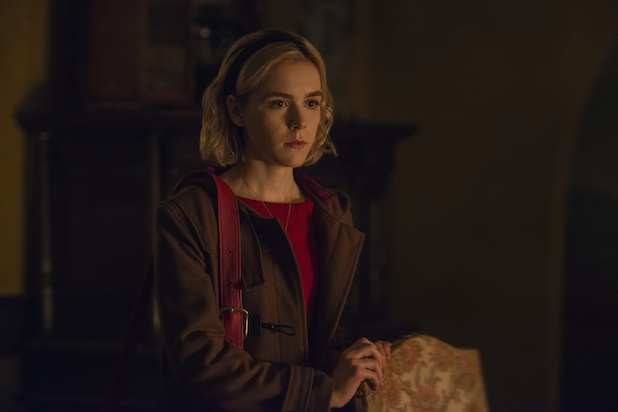

A steely determined Sabrina in The Chilling Adventures of Sabrina


Meanwhile, in Suspiria, as a psychotherapist investigating the Dance Academy, Dr Klemperer (Tilda Swinton, as actor Lutz Ebersdorf) represents male naysayers, the men who would see a woman in distress and call her hysterical, call her a witch and sends her to the stake: “When women tell you the truth, you don’t pity them, you tell them they are having delusions.” The presence of Dr Klemperer was a confusing choice for the new Suspiria. He doesn’t really serve much purpose, and the focus on losing his wife during World War II’s connection to the witches was weak. However, when viewed as a representative for male fear of female power, it only seems right that witches should be his downfall.

In Sabrina, pious Aunt Zelda’s decree “our obligation is not to question, but to obey and participate” is challenged as sixteen-year-old Sabrina rebels and quite literally questions everything. The young Kiernan Shipka is wise beyond her years with the level of earnestness and steely determination she brings to the role of Sabrina. This makes Sabrina’s crusade against the Dark Lord less like a kitten growling, and more a lion roaring. This is never more evident than at the end of the second episode where Sabrina, after running from her Dark Baptism, yells in a deep and powerful voice “My name is Sabrina Spellman, and I will NOT sign it away!”. In Suspiria, the old coven need a younger body to act as a vessel for the spirit of Mother Suspiriorum, which exists in the grotesque and deteriorating body of Mother Markos. But the reign of terror cannot last, and misconceptions become their downfall at the hands of Susie, in a ripper of a sick, sly third act reveal. Johnson holds complete control, and this subtle fierceness makes me wonder why we haven’t been worshiped at her alter all along. 

Susie (Dakota Johnson) surrounded by the coven of witches in Suspiria (2018)

Witches have become an empowering figure for women. The ability to summon unseen powers to wreak havoc on all who wrong you (especially men) is enviable. In a world full of social and political unrest, danger at every corner and full of uncertainty, harnessing power is a way to harness control over your life. With an influx of witchy vibes across Instagram and popular culture, this empowerment is especially felt and embraced by young women. With Trump in the Whitehouse, Millennials and Gen Z’s are at the forefront of enacting and demanding societal and political change. The Chilling Adventures of Sabrina and Suspiria speaks to that, whether intentionally (the former) or unintentionally (the latter).

The Chilling Adventures of Sabrina is now streaming on Netflix.
Suspiria is now in cinemas. 

--------
Teen Screen Cinematheque is a curated online project, presented by Cause a Cine, which aims to explore the intersection between teen screen (film and television), and classic and art cinema. You can read more TeenCinteq writing here.
By Claire.


This morning, my sister woke me up to tell me there was bad news overnight: after two seasons, Netflix has decided to cancel Sense8.

This announcement comes a week after the cancellation of Baz Luhrmann’s 1970s hip-hop and disco musical extravaganza The Get Down, another artistic and diverse master piece. Netflix may like to come off as a platform which champions diversity, but at the moment, is failing to keep that image up.

Created by Lana Wachowski, Lilly Wachowski and J. Michael Straczynski, Sense8 follows the lives of eight people from across the globe, who are interconnected in their minds, called “sensates”, allowing for these people to visit each other, feel their thoughts and emotions, and share skills to kick ass.

All 8 sensates together comforting Sun in Korea - So many different types of people supporting one another.

Filmed in sixteen cities and thirteen countries, what sets this show apart is not only the immense diversity of its characters, but also its production value, filming on location in each country the character is from and with local actors and film crew. From Seoul, Nairobi, Mumbai and Bombay, Mexico City, Sao Paulo, San Francisco, Chicago, Berlin, Reykjavik, London and Amsterdam, the show is literally the most global production seen on television.

Which is what makes the cancellation so disappointing.

In a review of the first season for Variety, Brian Lowry argued “‘Sense8’ becomes a pretty mundane, chaotic soap opera, following the lives of its various characters without doing much to advance what binds them.” I fail to see how this is a bad thing. 

Not only are we living in one of the most exciting time for television, where production values are bigger, the stories are more inclusive, and it is television shows which have more of an effect on society than film, but we also live in a time of intense international turmoil. So Sense8 may be turning more into a “soap opera”, about the characters lives rather than advancing what connects them, I don’t see this as a bad thing. (sidebar: was I the only one seeing all the action, fight scenes, and the whole cluster—what the group of sensates are called—banding together to defeat the enemy aka BPO?) Having a show where eight people around the word, from different cultures and ways of life, all banding together and helping each other in any way possible, is so important and life affirming to see. What connects us is our humanity, that we all live on this earth, and nothing demonstrates that more than Sense8.


Miguel Ángel Silvestre as Lito and Alfonso Herrera as Hernando at the Sao Paulo Pride Parade.

Actress Tina Desai, who plays Kala from Mumbai, told The Hollywood Reporter, "We might be culturally different, but we all think and feel the same way. If we can just respect that difference and then get over it and be more accepting, there really isn't any problem. The problem comes around when you resist change. That's what the show is doing: We all get past our differences and create something really amazing." 

The show teaches empathy, teaches tolerance. Wolfgang Bogdanow (Max Riemelt), a grumpy tough guy from an East Berlin crime family can blow up his uncle with a rocket launcher one scene, and help kick a homophobe’s ass in the next. Kala Dandekar (Desai), a devout Indian chemist can find out her husband’s company sends expired medicine to countries like Kenya, and feel the most intense betrayal. Sun Bak (Doona Bae), a Korean business woman who is an insanely skilled fighter is the one to help Capheus Onyango (Aml Ameen in season 1, Toby Onwumere in season 2), a tall and solid, Kenyan man fight his battles with her martial arts. A joke around the Sense8 fandom is that Will Gorski (Brian J. Smith), the All-American Chicago cop is the Cluster Dad, and Riley Blue (Tuppance Middleton), the Icelandic DJ is Cluster Mum. Although they come from different worlds, Nomi Marks (Jamie Clayton), a transgender woman in San Francisco offers advice and support to Lito Rodriguez (Miguel Ángel Silvestre), a Mexican actor who must deal with being publicly outed while in the spotlight.

Berliner Wolfgang Bogdanow (Max Riemelt, right) experiences Kala Dendakar's (Tina Desai, left) Mumbai through their connection. 

There is no accounting for how much this show means for a global audience as well. In a featurette uploaded by Netflix, actress Jamie Clayton says “I don’t think there’s one person in any part of the world who could watch the show and not feel connected to someone.” The show isn’t even just about people of diverse races, but also of sexuality, gender identity, religion, and subverting gender norms. In season one, Lito experiences Sun’s period pain; as mentioned above, the same woman helps a man fight; one of the most intelligent people in the cluster, Kala, is a woman; and in the final episode of season two, it is a white man who needs to be saved.  

Left to right: Freema Ageyman as Nomi's girlfriend Amanita Caplan and sensates Doona Bae as Sun Bak and Jamie Clayton as Nomi Marks. 


Fans have taken to Twitter to voice their disappointment, with Vine star Thomas Sanders writing:


A petition to renew the series has already be created.

In addition to the shows immense diversity, it is also a stunning and artistic production. Filming on location, instead of in a studio, provides an authenticity to the show and the character’s stories. The scenes are like pure art forms, and the editing is flawless. In a show where people are connected mentally, the ability to effectively show how the characters visit each other, but are unseen by those around them, is incredibly detailed and tricky to orchestrate, yet the editors pull it off seamlessly.


Some of the incredible editing. Source.


Not only do platforms such as Netflix need to champion stories of diversity, but they should also celebrate project which extend the boundaries of what a TV show is. To move forward in an already constantly changing industry, with the development of technology and a plethora of content already out in the world, isn’t it time to be bold and take risks in new formats? No other show does what Sense8 does. It is purely unique in its scope. Why doesn’t Netflix see the merits in that?

Netflix CEO and founder Reed Hastings told CNBC the platform has too many hits and not a high enough cancellation rate. If Netflix needs to cancel shows, why did they renew the teen drama Thirteen Reasons Why, which glorifies suicide? What will connect the characters now that the tapes are over? I will admit, I enjoyed the show and I think it demonstrates what it’s like to be a teenager in an adult way, but I don’t think it needs a second season. It’s lost on me. Sense8 comes together to fight a common evil both literally with the corporation BPO, and figurately in fighting bigots with lack of understanding. Love, empathy, sex and courage: This is what Sense8 is about, and I want to see more of that.


Bring Sense8 back.  

---

Both season's of Sense8 are available to stream on Netflix.


Cause a Cine do not own any of the images used in this post.
By Rachel

** Warning: Spoilers and discussion of sexual assault


Now finished its third and final season, the newest episodes of British crime drama Broadchurch have revealed many things to its viewers that were never thought possible in previous decades of the genre. Strong-willed female characters can dominate crime and (no surprises here) still make it great television. Some offences (not necessarily of the criminal type) are forgivable and can even change a person’s life for the better. And, perhaps most surprising of all, Detective Hardy can be found on Tinder.

Amongst the crime and the intrigue, there is a consistent sense that women are integral to the unravelling plot of this show. A no-brainer for some – of course women work in law enforcement – but there is still a persistent domination of the crime genre by male characters, providing not-so-nuanced perspectives of criminals and their wrongdoings from a male point of view, even regarding crimes that specifically affect women. On the other hand, Broadchurch provides the viewer with an insight into a more diverse police force. This allows for a subsequently distinct outlook on crime and the people affected by it.

Detectives Miller and Hardy make one unstoppable team. (Image Source)

Season Three in particular has demonstrated a very unique portrayal of sexual assault in only eight episodes. The season begins with local woman Trish Winterman (Julie Hesmondhalgh) speaking to Broadchurch police after being raped days earlier at her friend Cath Atwood’s (Sarah Parish) 50th birthday party. What will surprise viewers is that Trish is in her 40s, and not particularly representative of the rape victim stereotype reflected in other crime shows. Trish is mother to a teenage daughter and recently separated from her husband, Ian (Charlie Higson), also in attendance at the party. It is later revealed that she has been sleeping with multiple sexual partners following the separation, including Cath’s husband in a one-off affair on the morning of the party. A thought-provoking binary – on one hand, Trish has experienced an undeniably brutal crime and, on the other, has committed an in many ways unforgivable offense against a friend.

Of course, a brutal rape and a consensual sexual indiscretion are in no way comparable. Nevertheless, after hearing the news of the affair, Cath lets her anger get the better of her, incredulously asking: ‘Of all the women at that party, why would someone rape you?’ Cath’s situation is not enviable – she is seemingly stuck in a marriage devoid of love and intimacy, and has just lost a close friend due to a moment of weakness and a bad decision. But ultimately, we side with Trish – she makes some terrible life decisions, as almost every character in the show does. However, none of her minor wrongdoings are deserving of punishment by a horrifying sexual assault.  

She is portrayed as an everyday person, trying to survive a slightly messy break-up with her husband, but having a bit of fun in the meantime – and who can blame her? But the writers of Broadchurch are in one way testing the viewer – does our perspective of Trish as a survivor of rape change after we learn the news of the affair? It shouldn’t, and this is indeed one of the novel elements of the show.  

Trish revisits the scene of the crime with Detective Miller and Beth Latimer. (Image Source)

Again, this might be a no-brainer – of course a rape committed by another person has nothing to do with the victim’s life choices. But past film and media would suggest otherwise. When Jill Meagher was raped and murdered by Adrian Bayley, a criminal whose past crimes should have been enough to encourage the public to focus on what he had done wrong, Jill was instead criticised for walking home at night rather than getting a taxi or accepting a lift from a friend. Speaking to the press regarding the murder of 17-year-old Masa Vukotic in almost broad daylight at 7pm (during daylight savings), homicide squad chief Detective Inspector Mick Hughes suggested that women walk or run with a companion in parks rather than alone. Well, maybe we should just lock ourselves up inside (where many of violent crimes against women occur anyway) and not interact with the public at all? When men are murdered in public, why is no similar suggestion made?

Alcohol consumption, level of sexual activity, how one dresses - all are aspects of a rape case that, when mentioned by the media, suggest the victim intentionally chose to be in a particular place, in a particular state, with the full knowledge that they would be raped. (In the now over-quoted film Taken, for example, it always bothered me that the more sexually willing friend of Bryan Mills’ daughter who invites the kidnappers inside is raped and drugged to death, whilst her naïve friend – a virgin – escapes this fate. Perhaps not an intentional metaphor, but an unwelcome one all the same.)

In Broadchurch, Detectives Ellie Miller (Olivia Coleman) and Alec Hardy (David Tennant) reiterate over and over again to Trish: ‘This is not your fault.’ Trish’s one-time affair with Jim Atwood (Mark Bazeley), whilst somewhat relevant in terms of finding a suspect, is not at any point made an issue in terms of the reliability of Trish’s story. Miller and Hardy believe Trish, and they want her to know that.

Meanwhile, Miller is dealing not only with the personal aftermath of Season Two, in which her husband Joe is acquitted of murdering Danny Latimer, but with the recent actions of her teenage son. Reeling from the crimes of his father, Tom (Adam Wilson) is caught at school with pornography on his phone. Miller is furious – in many ways that you would expect, at one point smashing his laptop with a hammer when she discovers him with the porn still on his phone. This reminds us that Miller is exposed to the threat of sex crimes in a way that her son is not, and seems to connect pornography with the rape culture still prevalent in their town.

Miller’s aging father comments that these days everyone’s a victim of rape, reflecting the still unbelievably strong conviction that intoxicated women cannot be victims of sexual assault. Miller proceeds to inform her son of how important consent is, no matter what the situation; she wants to make sure that Tom does not commit the crimes of his father or the unidentified rapist, and she views his exposure to porn as relevant to this.


 Michael Lucus (left), the later-revealed rapist, shares pornography with Detective Miller’s son Tom (right). (Image source)

Whilst no character is perfect, the writers’ emphasis on the flaws of a large number of the town’s male population can’t really be denied. In this season especially, we’re introduced to serial cheater Jim Atwood, stalker Ed Burnett (Lenny Henry), installer-of-software-on-ex-wife’s-computer-so-he-can-spy-on-her Ian Winterman, and, finally, the person responsible for the rape – 16-year-old Michael Lucas (Deon Lee-Williams) who has been ‘groomed’ to assault women by a slightly older and arguably more despicable man (who many viewers would no doubt consider the true villain of the story).

And yet, even after seeing the intense trauma experienced by Trish as a rape survivor and the desperation of Miller and Hardy to apprehend the person responsible, the final result is a sad, unsatisfying, one. Rather than feeling outright fury towards the rapist, I felt mixed emotions of anger, incredulity, and sadness This is because a young, extremely impressionable man has committed a horrifying, life-changing act. Trish, too, on hearing the news, appears more shocked than angry, because her rapist is a boy that her daughter knows from school.

We are reminded that just as rapes can be committed against anyone, so too can anyone become a rapist. Whether in cases of alcohol consumption and ‘confusion’ over consent, or of more aggravated assaults and kidnappings, Broadchurch demonstrates that rapists are not ‘monsters’ – many, if not most, are what society considers ‘ordinary’ men; the men that we don’t expect to be committers of violent sexual crimes. 


As Tom Meagher, husband of Jill Meagher, wrote following the conviction of Adrian Bayley, the public and the media must no longer spread the pervasive ‘monster myth’ of the rapist. The idea that brutal rapists are inhuman monsters, whilst other, supposedly less serious sexual criminals, such as someone’s husband, boyfriend, or one-night stand, are just people who ‘make mistakes’ is a dangerous one. Although Hardy may tell Miller that Leo Humphries (Chris Mason), the man who pressures Michael to rape Trish, is not like other men, the reality is that the actual rapist in this situation is a seemingly ordinary teenager, with an undesirable home life, who is peer-pressured into assaulting a vulnerable woman. And yet, as ordinary as he is, he is still, and will always be, a rapist. That the ordinary can also be the despicable is a reality that many of us still need to come to terms with, and is something that Broadchurch portrays in a nuanced and confronting way. 

--
If you are feeling distressed, contact Lifeline
Phone helpline: 13 11 14

Website: www.lifeline.org.au/
by Claire


Disney Channel Original Movies and TV Shows have always had great feminist moments. The importance of friendship, self-acceptance and growth all being reoccurring themes.

While I don’t keep up with Disney Channel as much as I used to (RIP 00s Disney), and I assume you don’t either, I have stumbled across Girl Meets World, which has become my current obsession, and for good reason.

Girl Meets World is a title that may sound familiar to you (mostly in northern America, but it depends on how hip you are with 90s television). This is because Girl Meets World is a spin-off of ABC’s 90s hit Boy Meets World. If you’ve ever heard of the legendary TV couple of Cory and Topanga, Boy Meets World is where they are from. Fourteen years after the final episode in 2000, Disney has released a spin-off series, based on Cory and Topanga's family, but mainly on their 13 year old daughter Riley.

As the daughter of the fierce Topanga Lawrence, it is no surprise Riley has picked up her mother’s feminist spirit in the most recent episode (now in Season 2), titled Girl Meets STEM. For those who don’t know, STEM stands for Science, Technology, Engineering, and Mathematics, all subjects that have little female representation. 


In this episode, Riley’s class (along with her friends Maya*, Farkle**, Lucas and Zay) are divided into boy-girl pairs to conduct a science experiment. The instructions are simple: One student must return at the end of the day to drop a marble into a beaker, and the other student is to return the next day and figure out what the mysterious substance created by the marble is. 

In a move that is unsurprising, but nonetheless shocking, all the boy students automatically delegate their girl partner to drop the marble, while the guys “do the science.” This act is unquestioned, nor argued against, except by one person: Riley Matthews.

(From left) Lucas, Maya, Riley and Farkle hear about their science midterm. 

This episode looks deeper into what is on the surface (girls losing interest in science), questions why this is, and challenges it. Riley’s anger is used to awaken her fellow female students and fight back.


Riley refuses to drop her marble.

It is revealed that the science teacher has conducted this experiment every year for the past 35 years, as Middle School is the age where he notices girls start to lose interest in science—because the boy’s aren’t letting them.

Girls in STEM subjects is an issue Amy Poehler’s Smart Girls has discussed a lot in the past year, and is an important issue everywhere. STEM are male-dominated fields, for no reason other than girls feeling like they can’t, as demonstrated in this GMW episode.

While the episode was full of great lines, such as Riley listing the history of feminism after Farkle faints, one of the most memorable would be this: 

“By relegating me to a second class marble dropper, you are stopping me from realising my full potential.” 

Not only is this language very self-aware and sophisticated for an 8th grader, it reveals the problem with the system, and why there are few girls in STEM in one line. Boys take charge and girls are too often stopped form realising their potential. Girls don’t hear about other girls in STEM and thus do not know that they can.


Riley's mother Topanga and Riley help educate her fellow classmates on being feminists.

This episode is full of many joys, which had me cheering to myself on the couch more often than not. However, one of the most ground-breaking (in my opinion) things about this episode is the use of the F word. 

That’s right, on this Disney Channel show about 8th graders (currently), Riley and her best friend Maya ACTUALLY say “We’re feminists now.” Because guess what? ‘FEMINIST’ ISN’T A DIRTY WORD.

I love this show, and I loved this episode. Girls in STEM is hardly a topic covered in mainstream media (as far as I know) so it was really special to see it done so wonderfully here.

Rowan Blanchard, who plays Riley, is a feminist trailblazer herself, who will be featured in an upcoming post.

--

Girl Meets World airs on Disney Channel, Foxtel, weekends at 7.50am 


For all you Boy Meets World fans:
* Maya is the Shawn to Riley’s Corey
** Farkle's last name, Minkus aka Stuart Minkus’ son, but he is actually a core character and not a punchline, so yay team
By Odalis 

Seeing a notification on my phone about the Emmy nominations excited me immediately. I scanned through the main list quickly, nodding whenever there was a nomination I strongly agreed with.

It wasn’t until I saw a BuzzFeed article which bore the subheading “No Jane the Virgin?!...” that I became slightly ticked off.

I went back through the Emmy nominations and sure enough there was no mention of the show or of its outstanding leading actress, Gina Rodriguez. I immediately took to Twitter (as one rants) to express my disappointment—as best as one can do in fewer than 140 characters.

Jane the Virgin seemed silly at best when I first heard about it. A frilly comedy, from the CW no less, about a Latina woman who gets pregnant even though she still remains a virgin all because she was accidentally artificially inseminated. To my ears it sounded like the worst possible idea. Every Latina/o person I know, myself included, were wary and very aware of all the possible bad turns the show could possibly take.

I think it’s more than fair to say that everyone was in for a shock once the show premiered.

Andrea Navedo and Gina Rodriguez in Jane the Virgin

I remember watching the first episode and falling in love with the seeming innocence this show carried. The bright colors, the ridiculous “cannot be real” scenarios, and the dramatic telenovela narrator all found a place in my heart.

So much more than all aesthetic aspects that attracted me to this wonderful show is the wonderful actress, Gina Rodriguez. Born and raised in Chicago with Puerto Rican parents, Rodriguez is a testament of the immense talent Latinas have brought and are still bringing to the screen. Gina Rodriguez is an absolute vision as Jane Villanueva.

The most important aspect I found in the show is the casting of Miss Rodriguez—and the fact that a character with such depth as Jane was written as a Latina woman. Jane is a young woman who lives with her mother and abuela (grandmother), engaged with a lovely fiancé, and has definite goals for her future, which drives her every decision.

Ivon Coll, Gina Rodriguez and Andrea Navedo in Jane the Virgin

Unlike every other Latina character I have encountered on television Jane is not oversexualized, instead she is the one that is in complete control of her body—and none of the male characters have a say whatsoever.

Moreover, the show exemplifies the strength that is to be found amongst women. That while there are love triangles, love squares and love hexagons (after all, this is a take on a soap opera) the most important love comes from that of Jane’s mother and abuela. They are her support system in every sense of the word.

Even the seemingly villainous Petra finds a source of comfort through her mother, and at times Jane.

Finding representation like that is hard to find in this community, where the Latina characters are the maids, the secretaries, the Other Women, but they are never their own.

Jane the Virgin also isn’t afraid to tackle issues that Latina/o(s) deal with on a day-to-day basis in this country. One of those being immigration and immigration reform, the moral and religious basis of Latino households—and how to deal with that in a modern world, and the rather specific issues that come from being raised in a Latina/o family that you love no matter what.

The show is unlike anything I have every encountered in my many years of over-the-top TV watching.

Jane is much unlike Sofia Vergara’s character, Gloria Pritchett, in Modern Family (which stands at 6 nominations this award season) who is basically a caricature of the Latina woman. And yet, that is what people find funny—that’s the only way they find us funny.

Latina women can be funny and strong at the same time. Latina women can and are complex, and deserve more than just one identity. Yet consistently we are placed in a box, and not allowed to explore and expand.


I know it’s late to change any Emmy nomination (and really, who am I to do that?), but hopefully the voters, the board, anyone out there that has any kind of sway will realize for next year that not only does Jane the Virgin deserve all the acclaim it gets and more, but being honored with an Emmy could inspire many others in the Latino community to pursue their dreams. 


Odalis lives in Miami, FL and studies Journalism at The New School in New York. 


Cause a Cine do not own any images used in this post. 
By Claire


Filmed in 8 different countries, over 150 talking parts, an equal divide of male to female lead roles and a killer soundtrack, Sense 8 is the next Netflix original series to prove that diversity in a TV show is not that hard to do. 

The show focuses around a group (“cluster”) of 8 people from all around the world and their unique connection via senses. Also known as sensates. 


Sense8 is great for a number of reasons. First, it is filmed on location all around the world- in Mumbai, Nairobi, Berlin, Seoul, London, Reykjavík, Mexico City, San Francisco and Chicago- which is beautiful. This is no green-screen stylised culture: it’s the real deal. In each country, the show has used local crew and cast in order to capture the essence of each location. How cool is that?

Secondly, THERE ARE THE SAME NUMBER OF FEMALE LEADS AS THERE ARE MALES. WHAT?!

How often does a show have the same amount of female to male leads? Not very. 

Along with the four male leads (Mexican telvenova actor Lito, Chicago cop Will, Kenyan bus driver Capheus, and German jewel thief Wolfgang) there are four well-rounded and diverse women. 

Kala in Mumbai, a pharmacist who is devout to the Hindu god Ganesha. 

Riley, a DJ from Iceland (living in London), with a heart-breaking backstory. 

Sun, a business woman from Seoul and amazing fighter.  

Nomi, a hacktivist and transgender woman played by a transgender actress. 

These women are complex. At face-value they may seem like cultural stereotypes (Kala struggling with whether to go through with her wedding or not; Sun, the passive daughter willing to put her father and brother before herself) but it is the way the stories are built upon and developed that moves beyond these stereotypes.

Along with the diverse characters, the show also explores sexuality in a positive way. While it has been reported that every character should be seen as pansexual, Lito and Nomi are both in loving, committed, same-sex relationships. 

Lito's boyfriend Hernando and Nomi's girlfriend Amanita are 100% devoted to their SO's, and support them all the way. Loving, same-sex relationships that aren't destructive and have little drama are hard to come by on screen, but Sense8 makes it seem effortless, and yet engaging.

Another win for women in this Sense8 is the show is written and directed by the Wachowski’s (Cloud Atlas, Jupiter Ascending). Andy and Lana Wachowski are a brother-sister duo, meaning, along with the equal divide of cast members, half of the writing/directing team is also a woman.


The show is confusing at first (when you watch it for the first time, there are a lot of WHAT THE HELL? moments, but it is fase paced, and beautiful. You get to experience so many different cultures in an authentic portrayal. 

Men feeling the effects of a period, a killer international/psychological karaoke session, teamwork, kick-ass fight scenes, a bazooka???, a Bollywood dance sequence, smart-car stunts... Sense8 is insanely culturally enriching, and engaging. 

You will be hooked. 

(I may or may not have watched the 12 x 60min series three times in three weeks...)

Have you seen the show? What do you think? I’m interested to hear your thoughts!

--

Sense8 and the behind the scenes documentary, Sense 8: Creating the World are both available now on Netflix. A second season has also been announced.
Emmy nominations were released this morning, and with every awards show, there will be some celebrations but also many snubs. Throughout this piece I will go through some of the nominees and highlight a few favourites, as well as give my immediate reactions.


Actress Uzo Abduba and TV personality Cat Deely presenting the nominations (Getty Images)


OUTSTANDING DRAMA SERIES
“Better Call Saul”
“Downton Abbey”
“Game of Thrones”
“Homeland”
“House of Cards”
“Mad Men”
“Orange is the New Black”

As always, very happy to see Orange is the New Black nominated once again. The show has such a diverse range of interesting, exciting and sometimes frightening characters that it needs to be given recognition.

OUTSTANDING COMEDY SERIES
“Louie”
“Modern Family”
“Parks and Recreation”
“Silicon Valley”
“Transparent”
“Unbreakable Kimmy Schmidt”
“Veep”

The Unbreakable Kimmy Schmidt was definitely a show binge-watched in two days. The show is just plain hilarious, and Kimmy’s consistent positive attitude and strength makes you feel as though you can achieve anything. Likewise, it was sad to see the finale of Parks and Recreation, and say a final goodbye to Leslie Knope. A potential snub is definitely Broad City. 

LEAD ACTRESS, DRAMA
Taraji P. Henson, “Empire”
Claire Danes, “Homeland”
Viola Davis, “How to Get Away with Murder”
Tatiana Maslany, “Orphan Black”
Elisabeth Moss, “Mad Men”
Robin Wright, “House of Cards”
Orphan Black has such a strong fan following, and it’s great to see Tatiana Maslany being nominated this year. The fact that she plays multiple characters in one show requires such a talent and subtlety to portray each one. Furthermore, every women nominated in the category are phenomenal.
LEAD ACTRESS, COMEDY
Lisa Kudrow, “The Comeback”
Lily Tomlin, “Grace And Frankie”
Amy Schumer, “Inside Amy Schumer”
Edie Falco, “Nurse Jackie”
Amy Poehler, “Parks And Recreation”
Julia Louis-Dreyfus, “Veep”
This is definitely a tough category, proving the success of women in comedy this year. Amy Schumer has gained such notoriety this year through her funny, and yet thought-provoking sketches. No nomination for Ellie Kemper for Unbreakable Kimmy Schmidt? 
VARIETY SERIES
“The Colbert Report”
“The Daily Show With Jon Stewart”
“Jimmy Kimmel Live”
“Last Week Tonight With John Oliver”
“Late Show With David Letterman”
“The Tonight Show Starring Jimmy Fallon”
More of an interesting note, but there appears to be a lack of female variety show hosts. There are two Jimmy’s, but not one female? In fact, when it was found that Letterman was leaving, the American studios would rather get a Brit to fill the spot rather than a woman. WHY aren't there any female late night show hosts? 
SUPPORTING ACTRESS, DRAMA
Joanne Froggatt, “Downton Abbey”
Lena Headey, “Game Of Thrones”
Emilia Clarke, “Game Of Thrones”
Christine Baranski, “The Good Wife”
Christina Hendricks, “Mad Men”
Uzo Aduba, “Orange Is The New Black”
Uzo Aduba is definitely one of my favourite actresses at the moment. She steals every scene in Orange is the New Black, and just brings subtlety and honesty to such a complicated and interesting character. Lena Headey is also another favourite. Seriously, Cersei is just one of the coolest characters on television, and throughout season 5, Heady has dealt with some intense and tough moments, but every time she nails it.
WRITING FOR A DRAMA SERIES
- Joshua Brand for The Americans, “Do Mail Robots Dream Of Electric Sheep?” from FX Networks, Fox 21 Television Studios and FX Productions
- Gordon Smith for Better Call Saul, “Five-O” from AMC, Sony Pictures Television and Gran Via Productions
- David Benioff and D.B. Weiss for Game Of Thrones, “Mother’s Mercy” from HBO, HBO Entertainment in association with Bighead, Littlehead, Television 360, Startling Television and Generator Productions
- Semi Chellas and Matthew Weiner for Mad Men, “Lost Horizon” from AMC, Lionsgate Television and UROK Productions
- Matthew Weiner for Mad Men, “Person To Person” from AMC, Lionsgate Television and UROK Productions


DIRECTING FOR A DRAMA SERIES
- Tim Van Patten for Boardwalk Empire, “Eldorado” from HBO, HBO Entertainment in association with Leverage, Closest to the Hole Productions, Sikelia Productions and Cold Front Productions
- David Nutter for Game Of Thrones, “Mother’s Mercy” from HBO, HBO Entertainment in association with Bighead, Littlehead, Television 360, Startling Television and Generator Productions
- Jeremy Podeswa for Game Of Thrones, “Unbowed, Unbent, Unbroken” from HBO, HBO Entertainment in association with Bighead, Littlehead, Television 360, Startling Television and Generator Productions
- Lesli Linka Glatter for Homeland, “From A To B And Back Again” from Showtime, SHOWTIME Presents, Fox 21, Teakwood Lane Productions, Cherry Pie Productions and Keshet
- Steven Soderbergh for The Knick, “Method And Madness” from Cinemax, Cinemax Entertainment in association with Ambeg Screen Products, Anonymous Content and Extension 765


WRITING FOR A COMEDY SERIES
- David Crane and Jeffrey Klarik for Episodes, “Episode 409″ from Showtime, SHOWTIME Presents, Hat Trick Productions and Crane Klarik Productions
- Will Forte for The Last Man On Earth, “Alive In Tucson” (Pilot) from FOX and 20th Century Fox Television
- Louis C.K. for Louie, “Bobby’s House” from FX Networks, Pig Newton, Inc. and FX Productions
- Alec Berg for Silicon Valley, “Two Days Of The Condor” from HBO, HBO Entertainment in association with Judgemental Films, Alec Berg, Altschuler Krinsky Works and 3 Arts Entertainment
- Jill Soloway for Transparent, “Pilot” from Amazon Instant Video and Amazon Studios
-Simon Blackwell, Armando Iannucci and Tony Roche for Veep, “Election Night” from HBO, HBO Entertainment in association with Dundee Productions


DIRECTING FOR A COMEDY SERIES
- Phil Lord and Christopher Miller for The Last Man On Earth, “Alive In Tucson” (Pilot) from - FOX and 20th Century Fox Television
- Louis C.K. for Louie, “Sleepover” from FX Networks, Pig Newton, Inc. and FX Productions
- Mike Judge for Silicon Valley, “Sand Hill Shuffle” from HBO, HBO Entertainment in association with Judgemental Films, Alec Berg, Altschuler Krinsky Works and 3 Arts Entertainment
- Jill Soloway for Transparent, “Best New Girl” from Amazon Instant Video and Amazon Studios
- Armando Iannucci for Veep, “Testimony” from HBO, HBO Entertainment in association with Dundee Productions

As always with writing and directing, the discrepancy between men and women in the industry is very evident. Semi Chellas is the only female nominee for writing, and Lesli Linka Glatter for directing. Likewise, Jill Soloway is the only female to appear in both the writing and directing categories for comedy for the much-acclaimed Transparent. .
I wish all the women well in this category, and especially for being recognised in such a male-dominated one. Hopefully in the future, we can see a more diverse range of nominees.


The full list can be viewed here.
- Stephanie
Stephanie is Cause a Cine's Social Media manager and contributor.